Saturday, July 30, 2011

Review: "The Help" (opens Aug 10 -- US and UK)


Viola Davis in "The Help" photo courtesy of Dreamworks ©2011


review by Michael Orton
copyright 2011 ImageProviders
All Rights Reserved

At the Sundance Film Festival this past January, a memorable appearance by Harry Belafonte offered the young filmmakers in attendance a personal understanding of his involvement in the civil rights movement of the 1960s, and of his fervent desire that above anything else, they be society's radicals (his emphasis). Citing the Works Progress Administration and the work of Dorthea Lange and Ben Shahn, he described artists as "the caretakers of truth," and perhaps even guardians of our culture and that "radical thought is the energy of the Universe."

Harry Belafonte (right) "sitting"

Belafonte told those assembled that day that he felt he had been "fortunate to interface with the harbingers of radical thinking," people like Eleanor Roosevelt and Paul Robeson. "The power of art is not to portray life as it is, but life as it should be..." but he also warned, "To be a radical is to be an outcast. We definitely paid a price."

These themes multiply the force and effect of the Tate Taylor film version of Kathryn Stockett's 2009 debut novel, "The Help," a story set in and about Jackson, Mississippi and the Jim Crow south. With breakout performances by Octavia Spencer and Viola Davis (note that several Oscar nominations are predicted, here), and with Stockett's author adequately played by ingenue Emma Stone, the film also contains a stunningly appropriate cameo by none other than Cicely Tyson herself. When Ms. Tyson takes the screen, one feels as though history has indeed come alive. Allison Janney offers a welcome presence as part of Jackson Mississippi's plantation establishment and Sissy Spacek's unabashed comic relief allows the overarching social tension to be almost welcome.

(l to r) Bryce Dallas Howard, Sissy Spacek and Octavia Spencer in "The Help"

America in the sixties included television's "Andy Griffith Show" for those privileged enough to have "Ozzie and Harriet" and "Leave It to Beaver" memories of their childhood. Memorable for some but not for all during that convulsive time of our nation's history. Ironically, one of the most caustic characters in the story is very well delivered by Bryce Dallas Howard a generation after her father (director Ron Howard) was Andy Griffiths' cherubic "Opie" in the Mayberry series of the sixties. In "The Help," white hot performances including a revelatory soliloquy, delivered with piercing effect by Ms. Davis, help us truly understand that those famous years were not idyllic for everyone who lived through them. This is the transcendent effect of "The Help," and one that will definitely be recognized during Oscar's upcoming "For Your Consideration" season beginning in just six months. (Perhaps it is significant to note here that the nation's general election will occur only eight months after the Oscars are awarded this coming March).

And after viewing and feeling this story, which forcefully reminds us of how far we've come as a nation, one might conclude that as strenuous and painful as it was, the effort of Harry Belafonte, Martin Luther King and those other harbingers of radical thinking, was just The Help we needed.

"The Help" a DreamWorks release of a Reliance Big Entertainment feature

from the novel by Kathryn Stockett
screenplay by Tate Taylor
directed by Tate Taylor


Tuesday, August 3, 2010

Pushback on Technopush


Hollywood --

In today's New York Times, Michael Cieply writes about some pushback of the industry's massive attention to 3D technologies and also something predictable: The complication (ed. emphasis) behind "the industry's jump into the third dimension." Sorry, but we all saw this coming, right? At the NABshow in Las Vegas in spring 2009, the firstlings of 3D were showing up. This is a trade show (note previous posts here) that is largely technology-oriented with many engineers in attendance (IEEE and all that), so it's an appropriate forum for all of the breakout schwag and non-linear thinking.

Then, this spring, 3D was even a larger presence at NAB, no doubt fueled by the excitement of the mega-success of James Cameron's latest blockbusting effort, "Avatar" released the prior summer. Owing to the fact that (at least recently), much of Hollywood's production community and decisions are motivated by the gaming industry, this could accurately be called a calculated success. (Good that Mr. Cameron's track record equals his brilliant mind).

"Gaming industry," you ask?? (well, you might if you're older than forty) while you are lamenting the lack of film fare that you might enjoy, and longing for the time when a communal experience at the movies was also a night out that didn't cost what it costs today. Yes, and because you are not tied-in to the idea of "Comic Con" in San Diego, where the younger demographics are catered-to in detail, you should simply understand that the disposable income in this world is largely commanded by our 16-to-28 year-olds. Hence, a fascination by Hollywood to the confluence of comic book heros and intimate audience participation. Did this start with Spiderman?? We can't know. We do know that Michael Bay is prepping / shooting / animating "Transformers 3." Enough said.

Effects, Action or Scale

While the studio execs and the exhibitors still salivate over their 3D options (10% of the screens in America are now digitally able, a requirement of the third dimension) we are left with a dizzying lack of attention to the rest of our demographics by Hollywood studios.

The similar and historical situation to the "conversion" of black-and-white classics to "colorized" versions may give us a clue to what may happen next. The auteurs are already complaining about the possibility of their work being converted to 3D without their permission or desire, and audiences are still discovering what they will pay the premium, 3D ticket prices for. As far as (DreamWorks' chief production executive) Stacey Snider's comment that "It’s naïve to think we wouldn’t be having [3D] on any movie that has effects, action or scale,” we ask, is it naive to think that a film we'd like to see has a story..??? Would "Breakfast at Tiffany's" be more sellable in 3D?? That point is made by Mr. Cameron who designed the specific "gee whiz" 3D shots into his "Avatar." We were all impressed, but we were supposed to be. To his credit, Mr. Cameron planned the effective use of the third dimension. It worked, and he went to the bank while the industry thought they'd gone to the races.

Planned, not Applied

What you'll see in the near future: Several rock concerts are scheduled to be produced in Imax 3D, where ticket prices can be expected to be greater than average. (Interestingly, this at a time when many artists are arguing with promoters to reduce their concert ticket prices). We've seen Sony demo material where the crewe procession of Brazil's Carnivale with its resplendent colour is attempted to wow us in 3D, but, note to wanna-be directors of 3D: it doesn't. The reason why it doesn't is because the best 3D scenes have LOTS of foreground v. background composition, and this needs to be planned not "applied." The gaming crossover properties can do this kind of planning, and likely admirably so for their audiences. But conversions for the sake of conversions and a chance at more box office revenue just won't do. We are not holding our collective breath for "A Cabin in the Woods," in 3D. Please give us compelling story. If there's some effects, action or scale involved, so much the better.


Coming: A possible solution to the studios' inattention

Next: Comments and review of "The Help"


Michael Orton is a newmedia specialist and writer working in the west


Monday, July 12, 2010

Okay, You Be the Judge

Berne et Gstaad --

Msr. Polanski was released from electronic custody and house arrest in Switzerland earlier today, much to the dismay of the Los Angeles District Attorney's office who had sought to have him extradicted and to stand and answer charges which made him an international fugitive for more than twenty years. That recent story is widely known, as is the masterpiece he created from different story by Robert Towne who described his "Chinatown" as the "tunnel at the end of the light."

For me, this interview is among the best from a director, if only because it includes the effect which had Jack Nicholson's J.J. Gittes wearing a bandage on his nose for most of the rest of the picture. But... there's more to it than that. And if you're a film geek, it's worth :10:35 minutes.


Monday, June 21, 2010

The Maytag Effect

If you've ever pushed full-ocean scuba gear through the surfline and toward a favorite reef, especially on a day where the breakers were coming in pretty strong, chances are you've heard the term "the Maytag Effect." This is the time when, while wearing a wetsuit, lead weights, a 40lb tank, regulators, a bottom time computer and probably carrying a speargun, you find yourself caught in the biggest part of the surf and pounded mercilessly by all of the hydraulics involved. It can tear your facemask off of your face if you're not prepared. (Hint: Once you see it coming, go UNDER it and tuck your human pinipeds under yourself in a fetal-like position until the main agitation is over. Then resume your kick out to the place you're headed).

River kayakers get this idea, too. Especially on the Payette in Idaho during a record runoff. Sometimes its all you can do to keep the pointy-end facing downriver. Crabbing in the middle of the roiling whitewater is exhilarating beyond your imagination. Is that the river or your stomach churning??

No difference.


Props to the camerawork and assembly by Anson Fogel and team for their upcoming feature, "Wildwater."

Tuesday, June 8, 2010

Base Jumping at Dean's

Dean's Blue Hole -- Bahamas

Freedivers are unique in what they understand about their own tuning and performance. Imagine being able to not only hold your breath for almost four minutes, but to do work and remain mentally focused during all of that time.

It's a long time.

Especially if you calmly walk to the edge of a 600 foot sink hole and throw yourself into it face first, all while being entirely underwater. Underwater camera people are also unique. They despise bubbles that would distract the viewer from what they intended them to see. Often they use "rebreather" units that scrub the CO2 out of the air that recirculates in a closed system. But some of them just hold their breath, too. For this man and his shooter girlfriend, a free fall is different than others might experience. Dreamlike, even.


Guillame NERY AT THE ABYSS

The idea is that you become so comfortable in the water that your heart only beats a few times per minute. This is also because you are completely lean and physically conditioned into kinship with the aquatic mammals who divert their bloodflow to major organs during a dive. Quite tricky to do, because with each additional 33 feet of depth in the seawater column, there's an additional atmosphere of pressure that makes that breath of air you caught at the surface half as much smaller in your lungs. (Conversely, on assent, it expands, but at that time you've exchanged some of the O2 into CO2 and its the latter that tells your brain you are "hungry" to breathe air. Gulliame's poise in this clip would indicate that he keeps all of his hunger in check)

If you claim that kinship with the other aquatic mammals and believe that you have returned to an environment where all life began, then base jumping in a sinkhole isn't all that intimidating.

Maybe it's just a parallel dimension with another place and time.
Or maybe its just a dream.


Saturday, January 30, 2010

Augmented Reality at Sundance

The Sundance Film Festival, Park City --

Most of the time you might see the hashtag online or hear the conversational term "newmedia" at cocktail parties or around backpacking field reporters and cinematographers narrowcasting on specific blog interests. Internet citizen journalism is often referred to as a "new media" activity, among these others. So when Eric Gradman says the word "transmedia," around his augmented reality "Cloud Mirror," it tends to get one's attention. This is at least because David Granger and Esquire Magazine's "First Ever Augmented Reality issue" (Dec. 2009) allowed readers to download some resident software, find the unique symbols on several pages and then hold them up to their webcam to see their magazine come to life. (We especially liked the "Funny Joke from a Beautiful Woman" in that form)!! Augmented Esquire was in your hands and on your laptop screen simultaneously.

Monkeys and Robots is Eric's idea lab and prototyping company in Glendale, California where his projects leave concept to become some kind of reality. After seeing the website, we're thinking that someone'll be biggin' him up and that pretty soon he'll be doing some hush hush projects for the Rand National Defense Research Institute's ATP or NewsCorp. Afterall, Sundance called him and extended an invitation to exhibit at the New Frontiers on Main portion of the film festival.

In Eric's own words...


Eric Gradman and his augmented reality "Cloud Mirror" at SundanceTwentyTen

But it's his Virsix.com that has plans to knock the world of entertainment on its ear. What if you bought a ticket to an experience, one that would immerse you into a motion picture as your own gamepiece and with a game and story that you could then continue at home via the internet??


Discussing the "Virsix" collaboration in transmedia, "all supporting a single story."

Watch for additional applications using transmediated, augmented technologies and Eric's limitless brain. As you can see, neither are close to stopping yet, and it ain't your mama's arcademovietheaterinternet anymore.


The Prize Worthy Disturbance Continues

The Sundance Film Festival, Park City --

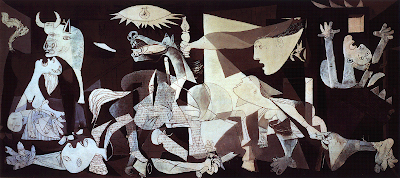
When these films were announced and screened, a couple of things came to mind. For those who have seen the 1984 Oscar-winning feature "The Killing Fields," about the life of Dith Pran, you'll understand what is meant by the expression "art that disturbs." This year's lauded Sundance entries "Restrepo" and "Enemies of the People" also have much in common with Picasso's monochromatic cubist canvas known simply as "Guernica."

Picasso's "Guernica," 1937

In 1937, as part of a protest of Franco's complicity with Hitler in the extermination of a Basque village in northern Spain, Picasso sent the painting to Spain's pavilion at the World Expo in Paris. An unapologetic denouncement of the atrocities that had occurred when Franco agreed to allow Hitler's airpower to test the effectiveness of "carpet bombing," Guernica now hangs in the Museo Reina Sofia in Madrid. Disturbing then and disturbing now. When one walks into the hall which displays "Guernica," its size immediately imposes its eventual impact. The canvas measures almost 26 feet wide and is 11 feet in height and was created at a time well before anamorphic aspect ratios were conceived for film.

Much has been and will be written about Sebastian Junger and Tim Hetherington's Afghanistan war documentary named after a fallen U.S. medic, Juan "Doc" Restrepo, who was also memorialized when the Forward Operating Firebase where most of the action occurs was named for him as well. In the first moments of the film, we witness Doc bleed out while being evacuated from the front in a futile attempt to save his bullet-riddled life. Sufficient to say here that Junger and his producer Tim Hetherington were able to get footage that almost killed them several times and allows viewers to understand the war in a very personal way. This film is not for the squeamish. It is shocking and stark and beautifully horrific.

"Enemies of the People" chronicles the efforts of Thet Sambath to infiltrate and expose the lives of Pol Pot's cronies who systematically exterminated millions of Camodians in the 1970s. The film documents his 10-year effort to get close to, document and then expose the men and women responsible for a generation of youth in Cambodia who were orphaned by the Khmer Rouge. The film picks up where "The Killing Fields" left off.

Yes, this kind of art is disturbing, but still very necessary. Artists who make paintings of World War II Spain, songwriters and performers who include lyrics exposing social injustice in Nigeria, and filmmakers who bring atrocities into our minds to expose those responsible, are owed our time and our attention if not our gratitude for the sacrifices they've made to create such a prize worthy disturbance in an otherwise comfortable society.

"Restrepo" - Grand Jury Prize Winner, Documentary - Sundance 2010
"Enemies of the People" - World Cinema Special Jury Prize, Documentary - Sundance 2010

more information on Sundance 2010 awards here.